Overview
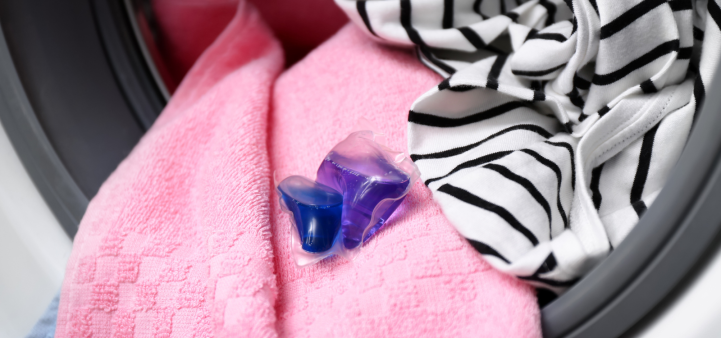
Polyvinyl alcohol (PVA) is a water-soluble synthetic polymer used in detergent pods and other applications. It is designed to dissolve in water and biodegrade under typical wastewater treatment and environmental conditions. Scientific and regulatory evaluations show that detergent-grade PVA does not behave like microplastics and does not persist as a solid pollutant in the environment.
Key Takeaways
- PVA used in cleaning products dissolves in water and does not remain as a solid material after use.
- Detergent-grade PVA does not behave like microplastics or persist in the environment.
- PVA used in cleaning products biodegrades under typical wastewater treatment and environmental conditions.
Scientific and regulatory reviews support the safety of PVA across multiple uses
You may have heard about polyvinyl alcohol, (also known as PVA or PVOH), a water-soluble polymer used in cleaning products like detergent pods and sheets. In these products, PVA is used as a dissolvable film that releases cleaning ingredients during use. There has been increased public discussion about PVA in detergents. We're explaining the science behind PVA and answering questions about its safety and how it behaves in the environment.

Q. Does PVA film leave the dishwasher or laundry machine intact?
A. No. PVA film is designed to dissolve completely in water. Detergent-grade PVA is specially designed to dissolve completely and biodegrade within hours in wastewater treatment.
PVA does not remain as a solid material in the environment. It has also been proven to biodegrade in river water.
Q. Does detergent film PVA cause microplastic pollution?
A. No. PVA is not a microplastic and does not cause microplastic pollution. Some claims about detergent-grade PVA are based in misunderstandings of how it behaves in water. These claims often confuse soluble, detergent-grade PVA with insoluble forms used in applications like textiles, and construction. Detergent-grade PVA is specially designed to dissolve completely. Research shows that detergent-grade PVA dissolves into single molecules, lacking a hard or solid surface, behavior that is completely different from known microplastics. This makes PVA more accessible to microorganisms, allowing it to break down more easily. This also means dissolved PVA cannot carry organic pollutants and cannot bioaccumulate. Solubility “down to the single molecule” means PVA does not form microplastics.

Q. Does polyvinyl alcohol persist in the environment as nanoplastic?
A. No. Polyvinyl alcohol does not persist in the environment as a nanoplastic. Some claims suggest that while polyvinyl alcohol may dissolve in water into smaller pieces, it does not actually disappear. However, these claims are based on insoluble grades of PVA and other materials that are not used in detergents. To the contrary, the grade of PVA used for detergents is specially designed to dissolve completely and biodegrades within hours in wastewater treatment. It’s also been proven to biodegrade in river water. There is no scientific evidence that detergent-grade PVA becomes microplastics or nanoplastics.

Q. When you toss a laundry pod into your washing machine, does the plastic go down the drain and pollute the environment?
A. No. PVA used in laundry pods does not contribute to plastic pollution. The claim, which has already been rejected by EPA scientists, is that even though PVA may not be visible to the human eye when it goes down the drain, it’s still contributing to our current plastic crisis at a massive scale. However, the PVA used in unit dose laundry products is water soluble and biodegrades in wastewater treatment plants (WWTPs) and the environment. This has been confirmed by the EPA.
More than 50 years of published science and regulatory reviews support the safety of PVA for use in diverse industries, including food, medicine and agriculture.

Q. Are there plastic particles from laundry detergent pods being released into oceans, rivers and soil?
A. No. PVA from laundry detergent pods biodegrades and does not release plastic particles. This claim was made in the International Journal of Environmental Research and Public Health based on flawed calculations and assumptions. It incorrectly argued that the conditions needed to completely degrade this plastic do not exist in most wastewater treatment plants or the natural environment.
The EPA published a detailed, point-by-point rejection of this claim, concluding that the journal article cited in support of these claims referenced data on true microplastics - not the water-soluble grade of PVA - and failed to acknowledge the substantial amount of existing biodegradation and safety data on water soluble PVA.

Q. Does PVA have the potential to absorb dangerous chemicals and contaminants, antibiotics, and heavy metals and work its way back up our food chain?
A. No. Detergent-grade PVA does not absorb or transport harmful substances through the food chain.
The grade of PVA used for laundry detergents dissolves completely and biodegrades within hours of wastewater treatment, making it impossible for it to accumulate in other materials. Because it dissolves fully, there is no solid material for contaminants to attach to. EPA has verified this through decades of scientific research on the lack of toxicity of PVA.

Q. Compounds such as biocides, insecticides, herbicides, flame retardants, heavy metals, antibiotics and pharmaceuticals are present in wastewater. Could those be absorbed into PVA and get back to us?
A. No. Detergent-grade PVA does not act as a carrier for substances like biocides, insecticides, herbicides, flame retardants, heavy metals, antibiotics or pharmaceuticals.
There was a paper stating that PVA absorbs lead and cadmium, yet this was done on solid, insoluble particles of PVA that are entirely different from those used in detergents. The grade of PVA used for laundry detergents dissolves completely in and biodegrades within hours of wastewater treatment, making it impossible for it to accumulate other materials. Because it dissolves and biodegrades, it cannot act as a transport mechanism for heavy metals or other contaminants.
Furthermore, PVA is approved by the FDA for safe use in a range of food, medicine and agricultural products that are ingested by people every day. The study itself concluded that it would be impossible to identify the source of the detected material and it was more than likely not from detergent products.

Q. Has the PVA used for detergent pods been found in human breast milk?
A. No. Detergent-grade PVA has not been found in human breast milk.
There are different types of PVA with different levels of solubility. A study found one PVA particle in 34 samples. That particle was brown in color, whereas PVA designed for detergent films is clear.
PVA is approved by the U.S. Food and Drug Administration (FDA) for safe use in food, medicine and agricultural products. The study itself concluded that it would be impossible to identify the source of the detected material.

Q. Does the PVA used in detergent pods impact fish health and does that mean it could impact human health?
A. No. Detergent-grade PVA does not impact fish or human health under typical use conditions.
There are different types of PVA. One study showed an impact on fish health, using a non-water-soluble form of PVA, which behaves differently and is considered a microplastic. The grade of PVA used in detergents, pharmaceuticals and food is water soluble and the environmental safety (algae, daphnia, and fish) and mammalian safety has been confirmed by the EPA, FDA and other agencies around the world.

Q. Are an estimated 20 billion plastic pods and sheets being sent down drains and into waterways each year in the U.S.?
A. No. Pods and sheets are made with polymers that do not persist in the environment, not traditional plastics.
Some claims suggest that all pods and sheets are wrapped in a persistent plastic, but this is not accurate. Data in the published and peer reviewed literature support that PVA dissolves and biodegrades in wastewater treatment plants and the environment.
Pods and sheets are some of the most widely used cleaning formats because they are convenient. Their concentrated format also makes them sustainable, reducing packaging and transportation impact on the environment.

Q. Is microplastic from PVA one of the most ubiquitous wastewater pollutants in the U.S.?
A. No. PVA is not a source of microplastic pollution in wastewater. Peer-reviewed journal articles show that detergent-grade PVA biodegrades in typical wastewater treatment plant conditions and in the environment.
There is no scientific evidence that detergent-grade PVA becomes microplastics.

Q. Do wastewater treatment plants (WWTPs) have the ability to biodegrade PVA?
A. Yes. Wastewater treatment plants biodegrade detergent-grade PVA.
Some research has estimated that a large percentage of intact plastic particles from detergent pods enter the environment; however, these estimates are based on modeling assumptions rather than direct testing.
The EPA, which has the authority and necessary scientific expertise to regulate cleaning product chemistries, has already explicitly and definitively rejected these claims.
Additionally, the study did not follow EPA’s guidance on how to scale degradation rates from laboratory-based studies to modeling of full-scale wastewater treatment plants. The analysis also included unsupported assumptions and calculation errors that significantly affected the results.

Q. Would taking pods and sheets off the market negatively impact consumer choice?
A. Yes. Removing pods and sheets from the market would reduce consumer choice. Consumers value a range of product formats based on performance, cost and convenience, as well as sustainability considerations. That’s why the PVA in detergents was designed to meet the strictest environmental standards. In addition to biodegrading quickly, PVA allows the product to be compact, highly concentrated and have a lower carbon footprint.
PVA also enables products that dissolve effectively in cold water, which can reduce energy use in laundry by 90%.
Alternative formats, including liquid, powder and tablet detergents are available. This is true; however, pods are an important option for ease of use and accessibility for many consumers.

Q. Did lab testing to show PVA biodegradability (the OECD series) use specific microbes in order to show the best case scenario and not the likely situation?
A. No. PVA biodegradability testing has not relied on special or uncommon microbes. It used microbes typically found in wastewater treatment facilities and in the environment. The testing methods were not optimized to artificially enhance degradations, but instead reflect conditions commonly found at most wastewater treatment plants.
Claims were made that very specific microbes need to be present to degrade PVA that don’t exist at most wastewater treatment plants or in the environment, and that PVA needs extended exposure times (28+ days) to degrade. Based on available peer-reviewed science, the EPA addressed and refuted these claims.
Conclusion
Polyvinyl alcohol (PVA) is a water-soluble polymer used in detergent pods and other applications. It is designed to dissolve in water and biodegrade under typical wastewater treatment and environmental conditions. Scientific and regulatory reviews consistently show that detergent-grade PVA does not behave like microplastics and does not persist as a solid pollutant in the environment.
Sources
- Biodegradability of Polyvinyl Alcohol Based Film Used for Liquid Detergent Capsules, D. Byrne, G. Boeije, I. Croft, G. Huttmann, G. Luijkx, F. Meier, Y Parulekar, and G. Stijntejes, De Gruyter, March 2021.
- Raw Materials Supplier and Detergent Manufacturer Cooperate in Environmental Safety Assessment of a New Detergent Raw Material – A Case Study, F. Meier, N. Stetler, D.M. Lee, N. Zeese, J. Tolls, SOFW Journal, 139, March 2013
- Some Characteristics of Pseudomonas 0-3 which Utilizes Polyvinyl Alcohol, T. Suzuki, Y. Ichihara, M. Yamada, and K. Tonomura
- American Cleaning Institute: The Truth Behind the Biodegradability of PVA/PVOH
- Environmental Protection Agency, Letter Denying Blueland Petition to Alter Status of Polyvinyl Alcohol Use on EPA Safer Chemical Ingredients List, April 21, 2023
- Environmental Protection Agency, Federal Register notice, Detailing Complete Rejection of Blueland Petition to Alter Regulatory Status of Polyvinyl Alcohol, April 21, 2023
Updated: April 6, 2026